Friday, October 2, 2026

The Donkey Kong Island Hexcrawl - Music and Magic


    Howdy, Farmhands!

    I need to level with you for a moment. This post is going to be me telling you about Donkey Kong lore for multiple paragraphs, with a small chart at the end that isn't terribly gameable. You are going to read it anyway because you love me and want me to feel appreciated. You wouldn't make a 35 year old man cry, would you? No? Thought not. We will get through this together. 

    During the Gamecube era, Nintendo released a peripheral known as the DK Bongos. They were a controller made of two Bongos. You hit the bongos to input commands. It was very weird. 4 games went to market with explicit compatibility with these Bongos, 3 rhythm games by Tatsunoko known as "Donkey Konga" and an adventure title by Nintendo EAD called "Donkey Kong Jungle Beat." A 5th game intended to make use of the Bongos for the Gamecube was moved to the Wii and converted into a motion control game- Paon's racing game, "Donkey Kong Barrel Blast." 

    The Donkey Konga trilogy was, to my knowledge, the reason the add-on was even developed to begin with. You hit the bongos in time with the song, gathered points, which were called "Beats" and aimed for the best possible score. Donkey Kong Jungle Beat, again, was an adventure title, with a more traditional level system for DK to travel through from point A to point B. As all actions were controlled via the DK Bongos, you were required to not only move Donkey Kong through platforming challenges with fucking Bongos, you were expected to chain actions together in order to acquire points, or "Beats," and aim for the best possible score. Donkey Kong Barrel Blast was a pretty bad racing game and is only mentioned here because the monkeys flew through the sky with jetpacks made of bongos, but held in front of them so they could hit the bongos to make the flying happen. It was a weird fucking game. I don't know if the original planned Gamecube release would have used "Beats" as a point system to fulfill the rule of three for this paragraph, but I'd like to think it would have.

    This era of DK eventually passed. Paon made some handheld games, DK himself continued to show up in Mario Party, Smash Bros, and Mario Kart, but overall things went quiet until Retro Studios got to make the DKC Returns Duology. Then Nintendo EAD (Now Nintendo EPD) shifted their Mario Odyssey sequel to be a new Donkey Kong game! What a fun and wacky history this ape has had. They even got King K. Rool to return after being absent for a decade, that's great! They really know what fans of this series want.

    Hey, what's he saying in this cutscene-

Oh FUUUUUUUUCK they've made it MEAN something.

    This is a single line and frankly, I don't think I've seen a ton of Donkey Kong fans on the internet do anything with this other than register it as a neat call back. Bananza is a game that makes heavy use of music- textually all of DK's brand new transformations in the game are triggered by Pauline singing the relevant song. Performing music triggers changes in the environment, directs players towards objectives, and, again, makes your big monkey become and even BIGGER monkey once you learn the right tune. Referencing the fact that music has a beat, and then hitting your big belly to trigger your own transformation is just riffing off of that for one final boss, right? Well...I mean, if we backtrack to just the last developers to make something for the franchise, we get these fucks.

Tikis your Tak Tribe

    
And yeah, no, these are just instruments with eyes. Like straight up, the Tiki Tak tribe are all musical instruments and their entire thing is playing music to cause changes in the environment and spell wild animals to do their bidding. Hell, their big boss, the largest and in-charge-est of the tribe is Tiki Tong, who's just one big Bongo. I'm sensing a through-line here, folks. Clearly music, and more specifically, "Beat" is a thing in this fictional universe. Maybe only the folks from Nintendo EPD intend to call it that specifically, but that's enough for me. Clearly multiple developers across three consoles felt this was a throughline worth chasing. It's just a shame there wasn't anything even further back during the Rare days- oh my god i forgot about donkey kong 64.

 DONKEY KONG SIXTY-FOUUUUUUURRRRRRRRRRR

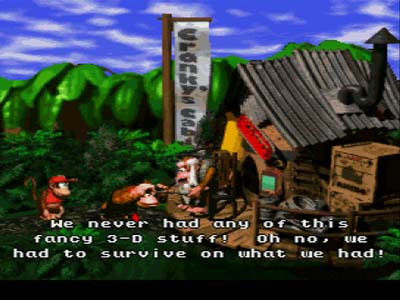
    Oh shit and these were references to the DKC trilogy! At the end of levels, some of the monkeys would pull out an instrument and play a little riff before running off! This arguably goes all the way back to the original opening cutscene from DKC 1 where DK kicks Cranky Kong off the treetops to beatbox with his stereo! It's been here all along! Music -does- things in this universe, and we have a specific name for it now, but it's always been present!!! Holy fucking shit, guys! And all the bullshit connections I've made thus far is before we start looking at the wider Mario-Universe the DK stuff sits inside; the entire first Mario & Luigi RPG was predicated on Princess Peach's voice being capable of waking up a magic star to make it grant wishes, for fuck's sake. Music = Magic. 

    Whewwwwwwwww.

    Ok, so like. That's over now. If you've scrolled down until the writing looked less insane, here's where the water calms. Thank you and I'm sorry for all that. I will definitely do it again as this project continues. Please don't unsubscribe here's the gameable stuff. 


    Magic on Donkey Kong Island is made with Music, but not just any Music will do. Specific Songs with Specific Intent can produce replicable results, making use of the performers' will, or "Beat" to make change in the real world. Most of these Songs were written down by the Kongs and Kremlings of old, lost along with their respective empires. It is still possible for someone to learn them, should the wind flowing through the trees harmonize with the Beat of an adventurous heart.

    Songs are comprised of an Action and a Target. Depending on the interpretation of this two-word descriptor, the in-fiction output of any single combination can vary by table. This is not a bug, it is a feature. When discovering a new Song, the player should roll on each of the following tables, then discuss with the rest of the Party to determine the effect and potential limitations of the Song, as well as give it a new name. All Songs need a title. It'd be rude to not give it one.

2d6 1-2 3-4 5-6
1 Summon Banish Friendly
2 Grasping Release Sealing
3 Leaping Diving Dashing
4 Change Hold Wild
5 Shrinking Expanding Dimensional
6 Draining Flooding Levitating

2d6 1-2 3-4 5-6
1 Vine Fruit Kong (Self)
2 Boulder Bees Kremling (Other)
3 Flame Parrots Kreature (Animal)
4 Wave Barrel Koncept (Concept)
5 Zap Temple (Building) Kreeper (Ghost)
6 Snow Gears (Machinery) Kontainer (Object)

    This will produce outputs such as "Hold Barrel" or "Shrinking Parrots." Whether or not this is useful is up to the performer. All Songs require a musical Instrument to perform, and one can find Bongos, Flutes, and such littered randomly across DK Isle that still retain the magic of a specific Song inside, waiting to be played. These Songs cannot be learned on their own, though their Instrument can be used to play other tunes the performer already knows. 

    Songs are noisy, and their effects may only last until the end of the tune. Changes that defy things like gravity will naturally end the moment reality comes back into play. Those that effect another's perception of the world may last up to 1d4 rounds after the performer has moved onto another set. It's impossible for a performer to focus on anything but the song they're playing; a wrong note will end the effect prematurely, after all. It's recommended that players come up with a specific tune for each of their known Songs. Not for gameplay purposes, but because it's fun. 

    You don't even have to locate a specific Character Pad to use them.

    Until Next Time,

        Farmer Gadda 

Thursday, September 24, 2026

System Considerations for The Donkey Kong Island Hexcrawl


Monkeying in the Design Mines

 You can read this post and find links to my other works over on my static site!
 Farmhands pledging $1 or more over on patreon got to read this a week early!
  

    Howdy, Farmhands!

    The Donkey Kong Hexcrawl comes from a relatively simple desire to role play within the setting and tone of the Donkey Kong Country series. I grew up with these games and want to imagine myself running around in that world. It doesn't really have to be any deeper than that- Gadda wants to pretend to be Monkey instead of Elf this week. But since I intend to do so with Other People who arguably should be as excited for this activity as I am, there's some further considerations to be had. Something I've learned over the years is that just because two people engage with the same media, it doesn't mean they digest that experience identically. Assuming such is the quickest way to destroy a shared imagined world, as the conflicting visions... conflict. Therefore, when attempting to adapt a property into the shape of an elfgame, I need to declare some goals and define some terms. What is Donkey Kong to -me-?

1. Exploration

    Donkey Kong Country 1-3 are masterpiece examples of putting hidden content in a video game. Breakable walls, barrel cannons at the bottom of deep gaps, hidden collectibles just off screen- every level is built with the expectation that players scour every pixel to find them all. These extra challenges and pathways made experimentation rewarding, not only giving those that found them extra loot (usually bananas), but also increasing their save file's completion percentage as proof of their bravery. The sheer joy of discovering one of these secrets makes each one incredibly memorable. The topography of the very first level naturally coaxing Rambi the Rhino directly into a hidden cave is iconic for a reason! 

    This is partly why I've chosen a hexcrawl as the base experience. I want players to see the map, know where the key landmarks are located and then... go exploring in the spaces between. Spending time and energy searching through a specific hex should reveal Something, even if that hex is "only" connective tissue between two major landmarks. I'm a big fan of Landmark, Hidden, Secret (who isn't, really?), and while it's use is not unique to hexcrawls, I find hexcrawls that employ it to feel extra Explore-y? Idk, it's mostly vibes based on games I've read and played. What I'm less interested in is the Logistical considerations of more traditional hexcrawls.  Time and the actions of opposing factions should be the largest barrier to access, instead of Rations or Carrying Capacity. Running low on Bananas should be a concern less because your character will starve, and more because without it, you can't take the shortcut through the thick forest without needing to stop and refuel every other watch. A Hexcrawl that's less of a challenge, more of an organizational structure.

2. Implication

    The Kremling Krew are a band of pirates, with bandanas and cutlasses and sailboats. Why, then, are they also armed with late 20th century Army helmets and Camouflage tank tops?  Why did Funky Kong become a Gun buff for a bit in DK64? What was this "Kremean War" the Brothers Bear mention when you visit the Northern Kremisphere? Something Happened, and it's left it's mark on everyone living in the region, even if they won't speak of it plainly. And what of the Aztec-inspired Kong Ruins spanning the entire island, when the Kong Klan itself is made of less than 20 individuals?  The shattered Kremling structures and sunken Kremlantis based on Greco-Roman architecture, when the stated homeland of the Krew is a single island off DKI's coast? The past of Donkey Island is colorful, but vague, and presenting those puzzle pieces to a table to make sense of sounds like so much fun.

    This is where the project becomes more like Fanfiction. None of the games were written with more overarching lore than was needed to produce the individual title. Much of Donkey Kong's history has had the ip bounced around to different studios frequently, and only in recent years has any corporate plan been put in place to cement the franchise as one defined thing. That hasn't stopped it's fandom from making connections or inferring meaning between games in it's sister/umbrella franchise, Super Mario, which leads to some fascinating concepts. Did you know that in one of the Mario Party games, 5 Bananas fuse to become a Power Star? Or that in Mario Galaxy, we're taught that Power Stars form from baby Lumas, the infant form of all life in the universe? All of existence is a cycle of death and rebirth, star dust forming into new life and continuing the cycle in perpetuity while deific beings have risen above it to form heavens from which they grant the wishes and dreams of the life below them including but not limited to being the sole source of procreation which they deliver via Stork!!!

    Ooooooh, Banana!

    I want to introduce these concepts to the Island and allow the Players to follow where it leads. I'm not interested in producing a complete history and lore bible of my personal interpretation of DKC trivia, but I do want to include these inferences to see what a table will make of them. Will they investigate the Star Spirits who beget sentient life upon the planet? Probably not. Will their conflict with the Tiki-Tak tribe make them question the life-giving properties of Banana Mush? More likely, and with a lore explanation if they're curious! Mostly I want the table to figure out what -their- Donkey Kong Island is like through play.  

3. Collection 

    Donkey Kong 64's reputation precedes it, though it's place as "The Game That Ruined Collectathons" is in dispute in the modern era. Really, it's record breaking number of collectibles is just the endpoint in a series of games with an increasing number of things to grab. Donkey Kong Country required you to find 67 Bonus Levels across it's stages to reach 101%. DKC2 had 75 Kremcoins and 40 DK Coins, both required to complete the game at 102%. DKC3 tops this at 85 Bonus Coins, 41 DK Coins,15 Banana Birds, and a minimum of 65 Bear Coins to complete the game at 103%. These numbers ignore additional currencies that can be acquired and spent repeatedly, such as Bananas, Balloons, and Kong Letters. Collecting quantities of shiny objects has been core to the experience from day 1.

    All that junk to nab works fine in a platforming video game, but I cant replicate the experience 1 to 1 in a ttrpg and expect players to be as excited about a Kong letter the 50th time as they were the first. That said, having a significant amount of loot is one of the joys of old school play, meaning I'm already leveraging my audiences' innate desire before figuring out how, exactly, to make collecting Bananas fun. 

4. Monkey Business 

    Donkey Kong Country is a video game made by British Developers using a Japanese company's IP for a largely American Audience. It's just plum goofy, really. And while early D&D is goofier than most people give it credit for these days, it would be super easy for me to accidentally lean into the darker implications and get lost in traditional elfgame dungeon crawling, forgetting that we're pretending to be cartoon monkeys! I don't want to do that. I don't want the threat of death and dismemberment, I don't want illness or starvation, but I'm using a chassis for games where you go into a hole and die there! I've struggled with this previously with my never-complete Sanic Hack and that experience will help me here. There is a sweet middle ground to be found. I swear it.

    Oh wait, did I get this far into the post without stating directly that I'm writing this with the assumption you're playing an Into the Odd hack or other OSR system? Cause I am. Fool of a farmer, I be. Sorry about that. 

    So, to recap, my goals are:

  1. Exploration: Places to Go, Things to See, Discoveries to be made Frequently and Easily
  2. Implication: Mysteries Raised, Connections Made, Few Answers with Players responsible for the rest
  3. Collection: Loot Generated, Resources Awarded, Stuff for Players to hoard
  4. Monkey Business: Keep it Silly, Keep it Light, Bad decisions shouldn't be punished TOO harshly.

      These will be the four pillars I keep in mind as I craft both the island, and the handful of homebrew rules to use while playing within it. God this post has gotten long.


    Let's talk about the swing I've already decided I'm making, then. Bananas will be Currency, Spell/Feat spending resource, and Rations. Only some of you will understand the joke if I call it "Banandium Archive". That's ok. Step 1 is to make Bananas slightly more accessible than gold. Dungeons have more of them, but you can find them fairly easy by just traveling about. Loot tables have a 60% chance of producing some bananas. You'll accrue a pretty pile of these, but only because you'll be spending them just as quickly.

CURRENCY

    Bananas as Currency means you can very quickly flip them into other resources and gear. All trade and barter should use Bananas, meaning it's always in demand. Need some Armor? Bananas. New Weapon? Bananas. Various Monkey Themed Services including Barrel-based Aviation? You got it; Bananas. There's an upper limit to having a hoard of Bananas on you, though- 100 Bananas can be traded in for Balloons, which are spent to revive your character when they fall in battle. There is very little utility to not handing in your entire stash the moment you can afford a Balloon. You'll find more the next time you go into a dungeon or search some tree-tops, after all.

    This entire idea assumes a Physical Table with tokens to manipulate. A fully digital game of this would require a ton of bookkeeping that I wouldnt personally find fun. I want people to reach into a bowl and pull out 20 🍌 tokens, then chuck 100 of them back in the bowl to recieve a 🎈 token. 

RATIONS 

    Bananas as Rations means that even if you stay in a safe location, your stock of them will slowly tick down. When you're flush with them, this barely matters, but once a sale is made suddenly youre risking deprivation and travel becomes costly. Some character options, such as playing a Tiki-Tak, will even have a larger daily ration requirement. This helps keep the Hoard small, while also incentivizing players to go out and do the exploration this is supposedly all about. It also means that large purchases, even the ever-helpful Red Balloons, come with an immediate concern; you're particularly vulnerable unless you go out of your way to find more Bananas and fast.

 SPELL/FEAT RESOURCE

    Spells in this project will appear in the form of "Songs." Essentially they are scrolls from which a Kong can learn a new tune, and playing it causes a magical effect. I've gone back and forth on this one, but think I like the following- In order to perform a Song (Or other sort of Feat.), the player must have previously prepared by eating Bananas above their daily ration requirement, up to a maximum I'll set later. Maybe 5? Spending one of these reserves allows the effect to happen as intended. Performing without reserves still works, but at risk of gaining Exhaustion and locking a slot of their inventory. (Of course, the clear condition of Exhaustion is eating an amount of Bananas outside of combat.)

    The choice at the start of the day is then, "Do I use up banana reserves when we might never see combat?", and in the moment, "Do I rely on my regular damage output or buff it to end this fight sooner at the risk of being weak for whatever comes next?" When the players know they have a surplus of bananas and are going into a dungeon where they'll inevitably get more, they'll naturally want to spend to be fully charged- -but then, do they spend the max and do a bunch of super moves or hold off and hope for good banana rng drops early on to buy one more balloon for safety's sake?

KONGCLUSION

    Going back to my 4 pillars, what does making the primary collectible, Bananas, work as Currency, Spell/Feat Resource, and Rations do towards supporting them? 

    This constant flow of doodads going in and out of the players hands should, in theory, produce a similar experience to the Collection pillar. The increased drop rate of Bananas and consistent need for them will promote the Exploration pillar. The act of constantly grabbing and relinquishing Banana tokens, preferably into a large bowl in the center of the table, certainly feels like Monkey Business. And if I wanted to stretch, the Implication of this cycle of Banana eating could lead to some very interesting questions at the table. If I weren't a coward,  I'd make the whole loop work faster by introducing usage die for tools and weapons, increasing the money-sink. That would push the experience a little too far from the light tone I intend to set, so for now, that will remain left out. 

    Until Next Time,

        Farmer Gadda 

Thursday, September 17, 2026

The Donkey Kong Island Hexcrawl - Introduction & Kongo Jungle


There's been plenty of good iterations of this place, 
but this version is the one that feels like home to me.

    Howdy, Farmhands   

    Five-ish years ago at the time of writing, I ran a TTRPG Actual Play for my Twitch audience titled "Escape from Kong Country." That AP took 6 or so months of planning and prep to even happen, and even then, that was after months of rolling the idea around in my head privately. What I'm trying to get at is that I've been thinking about roleplay games in the Donkey Kong world for a fairly long time. It wouldn't be until Josh McCrowell of Rise Up Comus began posting his own canon-adapting ttrpg project, "The Middle Earth Hexmap" that I decided to seriously take another whack at it. It helps that the immediate stumbling block I needed to pass was the question, "How do I even organize this thing?" Josh generously gave me permission to make use of his template. It's much easier to have a skeleton upon which to drape ideas than it is to stare at a blank page while those ideas wrestle in a cartoon dust cloud in your mind to decide which gets typed up first. It ALSO also helps that Josh has been forthcoming with his thought process on the project, how he approaches adapting works from beyond the original source material and filling in any gaps. Basically, I'd never have gotten my ass in gear for this without his work preceding me, so please go give his blog a good read. Buy his books maybe.

    Funnily enough, I've been sitting on what I've written for the last six months, so even this post is part of the process of dragging myself, kicking and screaming, towards the thing I desire. I briefly considered making this a daily excercise as Josh has,but I know that failing to keep up due to life or brain chemistry would simply upset me. Instead, I am posting this to introduce the project as a passive background activity, to fill in gaps where my other projects aren't ready for my loose self-assigned goal of "Posting Something Every Week." Might be a Comic page, might be a Livestream, but I have to post Something. Being able to sit down and knock out a hex or two is a good backup for when things go south. I've done it before with my contribution to the Rankin-Bass Christmas Hexcrawl.

    Similar to how that hexcrawl was made, I will be taking efforts to weave in connections between hexes. In the early days of this project, that will look like unfinished entries until I've gotten most of the adjacent locations written up as well. For this project, my primary sources will be Donkey Kong Country (SNES, 1994), Donkey Kong Land (GB, 1995), Donkey Kong 64 (N64, 1999), and Donkey Kong Returns (Wii, 2010). References and adaptions of stuff from other games that I feel fits within the main Donkey Kong Island will be dotted throughout, but the main goal is writing the island itself. I have split the place into chunks, each will have it's own regional encounter table atop individual hexes' encounters, in the cadence of Paper And Pencil's Structured Encounters. The hexes will remain unnumbered for the time being, as I'm still figuring out the exact form the final map will take. They will retain relative location to one another. Dungeons will have their own pages, and unfortunately that means a lot of empty spaces that amount to "add one of those here." It's a process.

     Quoting Josh on how to read the entries: 

HEX #

SITE NAME IN CAPITALS. The site name is mostly to help the GM remember the contents of the hex. The site description is given in Roman font. The type of terrain, which is needed for random sites or wandering encounters, is listed on the map. Particularly interesting sites where quests, rumors, random encounters, and interesting NPCs can be found are given in bold. Hidden features are given in italics.

HIDDEN SITE. Hidden features of the hex are presented in italics. These can only be found during certain times or by exploring the main feature of the hex.

! - QUEST NAME: Details a potential job for a burglar, if the players go sniffing around for work. 

✦ - OFTEN HERE: If the region is inhabited, a quick list of NPC names and descriptions for the GM to easily pull from. The number of NPCs is reflective of the size of the settlement, ranging between four and twelve. 

(d6): A special encounter could be here. Roll a d6. If the face equals the number shown, this event is currently occurring when the fellowship arrives, if it possibly makes sense.

       And for my own purposes, anything highlighted in Banana Yellow will link to it's own bespoke page once it's written, usually Dungeons. This is a Work In Progress, after all.


 REGION 1: KONGO JUNGLE

    Per MarioWiki: "The Kongo Jungle is a vast jungle found on Donkey Kong Island, at the foot of Monkey Mines. First appearing in Donkey Kong Country, Kongo Jungle is the place where DK's Tree House and the Banana Hoard is found; a distinction shared with the similar Jungle world in Donkey Kong Country Returns, which has been suggested to be the same location. It is known for its dense rainforests, including natural ranges of wild gorillas." 

     Kongo Jungle is split into two sections based on elevation, the lower jungle being where the majority of the Kong Clan live. The western half of the lower jungle is seperated from the east by upper jungle's cliffs, which extend to the ocean's edge, with a series of caves and tunnels allowing access to the east. A river coming down from the upper mountains empties into the ocean via the eastern half, and while bridges and rope swings have been installed to travel over, it still remains a danger. The eastern jungle grants access to the BEACH region, while the upper west jungle leads to the MONKEY MINES and CHIMP CAVERNS.

HEX: Jungle Japes Valley- A Hilly valley to the Northeast of Jungle Hijinks.

Jungle Pond: Surrounding a pond where vines grow, and caves are dotted along the cliff face. A cannon on the shore could be a shortcut to Ropey Rampage, if it were to be fixed by a mechanic.

(Players can spend a Watch to Explore the caves if they like. 1 – Encounter, 2-4 – Nothing, 5-6 Treasure)


Batface Cave-in (Dungeon)

A sinkhole reveals a lost temple to an unknown diety. The construction is of dirt and stone, far removed from the Kong temples of the island. Who left this?

- Tight walkways over deep pits

- A bat colony has taken refuge in here and dislikes light

- Giant bat head with a wide, gaping mouth. It’s eyes sparkle like jewels.

Shell Stage: A wide clearing around a raised stone platform. Multiple fallen logs have been arranged to form seating around it. There’s a massive conch shell sitting on the stage, with ominous buzzing noises coming from within.

! -
The rainbow conch used to be used to perform music for the Banana Fairies, but a hive of Zingers took over and made blowing it… difficult. Relocating the hive and allowing the performances to continue will make the Fairies very happy.

Magic Conch Shell (Dungeon)

Objects entering it’s opening shrink to fit inside.

Zingers have created a nest inside and need to be removed

<> Advancement Opportunity: If the players perform for the Fairies after returning the conch, they will learn a Random Song as thanks

HEX: Jungle Japes Cliffside: Overlooks Jungle Japes. (Northwest?)

Snide’s H.Q: .A lopsided shack with a tin roof. A radio dish and tv sattelite have been haphazardly nailed on top, but appear functional. A hand painted sign reads “Snide’s HQ” Inside, a series of pulleys and levers connect to rube goldberg machines that seem to serve no purpose and are made of junk. Blueprints for various questionable constructs litter most spaces.

✦ - OFTEN HERE: SNIDE THE WEASEL (Snarky, Stingy, Sleezy) A reformed Kremling member, though his turn came from spite as opposed to a moral shift. Capable of building fantastical structures, but requires payment up front. Honors his deals to the letter, and frequent successful trades will warm him up to the party.

! - Bon Voyage, Blueprints: Someone broke into the H.Q. in the night, and scampered off with 9 of Snide’s Blueprints. He can replace them easily, but he worries what someone might do if the work was reverse-engineered. He’ll pay 5 Bananas per party member for each Blueprint returned. (Every Kremling Member henceforth has a 1 in 6 chance of having a Blueprint visibly on their person until all 9 are found)

Mountain Hideout (Dungeon)

A cavern repurposed by the Kremlings to store scavenged ammunitions (very unsafe)


HEX: Thunder Cove - A Sparse Jungle at the ocean’s edge with a clear view of the sky. Large knocked over logs form tunnels between locations. (East of Jungle Japes)

Sacred Tree: A tall and mighty trunk devoid of foliage. Multiple braided red ropes are strung around it, marking it as a place of power. Despite being completely hollow, the tree is alive and waiting. Locals place offerings of bananas in the hope of good things happening to the Island.

(d6) 1: Konfu Kong is giving an offering of (d6) Bananas. If any member of the party owns a Crest, he will challenge them to find his hidden training grounds and fight him in combat. Once the training ground is found, regardless of the result of the fight, he will have a 3 in 6 chance of appearing at the Sacred Tree from that point onward.


! - If the Party offers bananas totaling these amounts, events will trigger (These Amounts are based on the video game and will need to be adjusted)

  • 1-399 : A Bronze Crest falls from the Tree,
  • 400-799 : A Silver Crest falls from the Tree,

  • 800-1,199 : A Gold Crest falls from the Tree,

  • 1,200 or more: A Platinum Crest falls from the Tree,


Hidden Waterfall - A log tunnel embedded into the ground leads to an open cavern with a sturdy rope bridge crossing the gap. A large waterfall fills the cavern and the underground river below. Konfu Kong can be found training his heart and mind in the waters. If approached, he will request a spar. Any who take him down in honorable combat will be allowed to use the path. (Connects to-[Future Hex])

✦ - OFTEN HERE: KONFU KONG (Strict, Shrill, Snobbish) Martial Artist, previously of the Boss Kongs. Dislikes weaklings but respects those who respect nature. Will train warriors who have received the Sacred Tree’s Badges in combat techniques.

HEX: Jungle Hijinxs - A valley at the base of DK Mountain.

DK’s House: A wooden cabin with a thatch roof atop a tall tree. The inside is littered with whatever cool shit DK and Diddy found entertaining enough, along with probably too many banana peels.

✦ - OFTEN HERE: DONKEY KONG "DK" (Goofy, Childish, Kind) De Facto leader of the Kong Klan. His primary motivation is Bananas, though the safety of his island and it’s inhabitants come in a close second. Friendly to anyone who shows him the same. Not terribly bright.

Flat plain surrounded by trees

dense jungle nearby

rising hill underneath which is a banana hoard (one of many)

bashing into cliff reveals hidden valley?

Landmark:
Hidden:

Secret:
Encounters: Gnawty, Klump, Kritter, Necky

HEX: Ropey Rampage (Northeast of Jungle Hijinks, inaccessible from Lower Jungle Hexes)

A series of cliffs atop a raging river. Ropes have been placed all over for swinging to and from each side. Individiual areas jut out as islands above the perilous drop. (this level is interesting for being in the rain and dark, otherwise it’s just a more vertical jungle hijinx.) the river idea isn’t bad. Leap of faiths into barrels leading up to even higher treetops. Lots of butterflies once the rain stops

Landmark:
Hidden:

Secret:
Encounters: Army, Kritter, Zinger

HEX: Reptile Rumble (East of Jungle Hijinks, grants passage to Lower East Jungle Hexes)

A cave system connecting the jungle to the southern beach. Features high ceilings but deep snake pits and secret side caverns. Multi barrel puzzles shooting players all over the place? Tight squeezes between areas. A big pit with a floating platform and a tire to balance on. Multiple kritters jumping down an incline at the player. Should this be a Flux Space????


Cranky’s Hut

Landmark:
Hidden:

Secret:
Encounters: Kritter, Slippa, Zinger


HEX: Coral Capers (South/Southeast of Reptile Rumble)

An ocean inlet filled with piranhas and octopi. The emerald green coral hides secrets. Home of Enguarde. Wandering patrolling Sharks? Ocotopi chase you in circles. Coral patches reveal hidden items, air bubbles? Clams taking potshots from below? Why would the players come here? What’s down there worth getting?

Landmark:
Hidden:

Secret:
Encounters: Bitesize, Croctopus, Chomps, Clambo


Thursday, September 3, 2026

Spoonsingers - A Mon-astic Order for Into the Oddish

Everybody WAS Kung-fu fighting! (wow)
"Alola Alakazam Fighting Type" by LoganCure on Deviantart 


You can read this post and find links to my other works over on my static site!
 Farmhands pledging $1 or more over on patreon got to read this a week early!
  

Spoonsinger

    Of the Martial Orders founded since the fall of Humanity, there are few as powerful and dedicated as the Spoonsingers. Masters of both Fighting and Psychic techniques, Spoonsingers forgo the common belief that training one's mind or body are exclusive goals. By harmonizing their physique with their honed wills, they have learned techniques of both types that blend and blur the physical and spiritual domains.

    To be a Spoonsinger, a Pokemon must be a Psychic or Fighting Type. Upon commitment to the order, the opposite Typing will be gained as a Second Typing. Gaining an additional typing in this way is irreversible. 

  • Role: While Spoonsinger Order maintains temples and training grounds to their teachings, most trained members choose to wander the region in search of new techniques and young Pokemon who show traits of Psychic or Fighting prowess. They do this by seeking out sources of strife and attempting to calm them, either through words or actions. They act as diplomat and one-mon army in turn, upholding their belief in balance and insuring the continued teaching of future generations.
  • Weapon Proficiencies: Spoon
  • Recommended Skills: Dancing, Etiquette, Juggling, Singing, Tumbling, Weaponsmithing.
  • Equipment: A Spoonsinger is always identifiable by the order's weapon of choice; the Spoon. Recognizable as a tool once employed by Humans, Spoonsingers will smith variations of it's shape and size to better suit the individual's fighting style. Such an item is always polished, enhancing the Spoonsingers appearance in battle.
  • Distinctive Appearance: Not only are they easily identifiable by their weapon of choice, Spoonsingers don a set of loose robes, colored to match their respective Temple. Each Temple has a distinctive palette, closely related to the nearest Human settlement, all of which were once known by colorful names. These robes frequently include an outer and inner set, the heavier hooded coats giving protection from the elements, and the lighter inner robes allowing for freedom of movement in combat.
  • Special Benefits: Spoonsingers benefit from the harsh training afforded any acolyte, as well as the combined resources of the Temples dotted across Kanto.
  1. As a result of the harmony between mind and muscle, Spoonsingers move with a supernatural grace, almost dancing across the battlefield. This trance-like state is known as Spoonsong, and is accompanied by a hum of psychic power interrupted by the clang of their Spoons as they strike in time. This display is both beautiful and haunting, and triggers a Morale save for the group once the first opponent falls to half health.

  2.  Spoonsingers may find shelter and supplies at any Temple, regardless of minor ideological differences. It is not unheard of to find a Spoonsinger from the border of Johto taking supper at a Temple on the coast of Lavender town. Parties who have allied with a Spoonsinger are welcome, though only temporarily, unless they wish to become members of the order themselves.

  3.  Accomplished Spoonsingers may choose to retire from wandering and become Temple Masters, taking the position over from their Elders or choosing to found a new Temple of their own. While any Spoonsinger can share the basic tenants and foundational trainings, most believe the art of Spoonsong can only be learned properly from a Temple Master. Their skills are kept sharp by the frequent challengers from both within and without the order; Trained Pokemon who have completed the Gym Battles of the region choose to test their skills against greater warriors, and the Temple Masters willingly oblige.
  • Special Limitations: Spoonsingers are expected to follow a set of restrictions in their daily lives, failure to do so could mean ejection from the Order. 
  1. Not only must they attempt to advance the outreach of their Temples at all times, they must also lend aid to any Pokemon in need, unless that Pokemon is proven to be an enemy to the Spoonsinger way of life. 

  2. They may not use TMs/HMs. To develop a technique without the use of your own training is counter to the core of the Spoonsinger Order; while non-members are not begrudged their choices, committed practitioners think of the practice as a disgraceful grasp for unearned power.

  3.  Spoonsingers do not wear protective gear or finery other than their traditional robes, though held items that enhance their Psychic abilities are generally overlooked. This is both cultural expectation and  a matter of efficiency, as holding a shield or wearing armor interferes with their acrobatic fighting techniques, and clothing of any value goes against the tenent of limited wealth.

  4. Temples offer a small stipend for purchases wandering Spoonsingers must make during their journey, though it is largely understood that this money is primarily to maintain their weapon of choice. Additional money and treasures found during their adventures is assumed property of their Temple of origin, and is to be gifted to it's accounts upon the Spoonsinger's return. This means that most Spoonsingers survive off the generosity of the Pokemon settlements they travel to, or by temporarily joining Adventuring parties to clear dangerous dungeons and fund the next leg of their journey.

After becoming a Spoonsinger, Players gain an additional list of Moves they can learn at the end of a battle. The player may roll before choosing which list they would like to learn from. 

1d20 Move
1-3 Vacuum Wave - The user whirls its fists to create a wave of pure vacuum that it sends flying at targets. Moves first in combat regardless of Dexterity save results. Deals 1d4 Fighting-type damage to the target. Usage: Unlimited
4-6 Psyblade - The user rends the target with an ethereal blade. Deals 1d8 Psychic-damage to the target. Usage: 1x per encounter
7-8 Aura Sphere - The user lets loose a pulse of aura power from within its body. Deals 1d8 Fighting-type damage to the target. Usage: 2x per encounter
9-11 Zen Headbutt - The user focuses all its willpower into a fierce headbutt. Deals 1d8 Psychic-type damage to the target. If rolling multiple dice and any two match, the target flinches and misses their next turn. Usage: 1x per encounter
13-15 Psycho Cut - The user launches blades formed by psychic power. Deals 1d8 Psychic-damage to the target. The attack is a Critical Hit if it rolls a 7 or 8. Usage: 2x per encounter
16-17 Psyshield Bash - Cloaking itself in psychic energy, the user slams into the target. This also boosts the user’s Defense stat.  Deals 1d10 Psychic-type Damage. On a Critical Hit, the user's ARMOR is increased by 1 (max 5) for the duration of the battle. Usage: 1x per day
18-19 Focus Blast - The user heightens its mental focus and unleashes its power in the form of a spiritual bullet. Deals 1d10 Fighting-Type Damage. On a Critical Hit, the target's ARMOR is decreased by 1 (max 5) for the duration of the battle. Usage: 1x per Rest
20 Secret Sword - The user pushes psychic energy into their weapon, extending it as an ethereal blade. This odd power is solid to touch. Deals 1d10 Fighting-type damage, bypassing ARMOR. Usage: 1x per day

 Sources: x, x


Friday, August 28, 2026

Vitamins - Stat Gain for Into the Oddish


It whispers to me like the Green Goblin mask. It says... "Pikachu... Pika pika." 
Which I think translates to either "Drink from me, Gadda" or "oh god i'm a disembodied head"
.

 You can read this post and find links to my other works over on my static site!
 Farmhands pledging $1 or more over on patreon got to read this a week early!
 

Howdy, Farmhands!

    Into the Oddish handles Pokemon Evolution in a very interesting way. Gone are the traditional methods of experience and levels, as Into the Odd does not handle advancement with those mechanics. One might still be surprised by this design choice because Pokemon very much hinges advancement on those mechanics specifically. 

     Here's how it works - Once a player Pokemon reaches a set requirement, usually having completed a number of "dangerous expeditions" or gained a number of Gym Badges, they are allowed to evolve. Evolving increases HP, Armor, and rollable Stats by an amount set by the specific evolution, usually with a die roll relative to how the Pokemon's stats would change in the original video game. Ivysaur gains 2d4 Hp, while Venusaur gains 2d6. Charizard gains 1d8 Dexterity, while Blastoise only gains 1d4. This setup does a couple of things- the first is incentivizing specific playstyles. "Dangerous Expeditions" means "go into dungeons and come back out alive." Gym Badges means "Engage with combat, specifically in organized competition." Either way, this is pretty clear direction for what the game assumes the player will be doing, without demanding they do both. 

    On top of that, the guided increase in stats using die rolls keeps a level of randomness in play while still making individual Pokemon different enough from each other; it's possible to roll 1 for every stat when you evolve, and you're stuck there. But it's also possible to roll max value and come out with the best odds for whatever you do. You're still better off being a Pokemon that naturally has better odds of rolling those higher numbers, but even the mightiest of Mons could suck shit with bad enough RNG. Notably, these stats do not translate into your ability to inflict damage as each Move has it's own specific damage die assigned to it. Adventuring in search of the TM that will let your Pokemon rise above it's peers is still viable for even the unluckiest of saps.

    The problem, if it even is one, is that once you reach your final evolution, this advancement stops. You can't evolve past your final stage, and while your Move pool can be changed via TMs and HMs, your stats become static. Only Pokemon with three stages are statted out as player options in the core book, but one of you fucks are going to homebrew in the remaining 103 eventually; Two-stage Pokemon will have the chance to change their fates Once, while Single Stage Pokemon are just fucked. The limited triggers for advancement, along with the chance that things could go horribly wrong with no recourse in the rules as written had me thinking. Weren't there mechanics in the original pokemon games to slightly nudge your stats in a certain direction? Something that required input from the player, performing specific actions that slowly but surely enhanced the stats on top of the already set in stone numbers related to a specific monster? ...Wait. Oh god no, I'm thinking of-

EFFORT VALUES 

    No, I'm not hacking EVs in 1 to 1, that'd be fucking insane. However, I did spend time researching exactly what this mechanic looked like during Gen 1 in particular, to see if there was something here I could use to guide my adaptation. You can read the entire article on bulbapedia here, but as a very quick tl;dr, "Stat Experience" as it was called in Gen 1 and 2 was a secret data set every pokemon had. When defeating another Pokemon, the value of their base stats were converted into points that were quietly applied to the relevant stat of the Pokemon that defeated them. When said Pokemon leveled up, the amount by which that stat increased was altered based on the amount of effort points they'd quietly accrued. This system was never meant to be player facing, but a way to simulate Pokemon being living creatures that weren't 100% under control by the player, and honestly it sounds pretty neat on paper. Obviously the mechanic has been dissected and hardcore competitive players know how to play it like a damn fiddle, but that's not what we're doing here today. Adding secret XP bars for individual stats will not work in a game like Into The Oddish. 

    On top of gaining these effort points from combat, there were a handful of items that could be purchased and given to your Pokemon, known as Vitamins. These items, when given, increase a relevant stat's EV by a set amount, though the equivalent items that affect HP and PP have different math due to their focus. Games in  Generation 3 and onward set this amount at 10 EV with a total cap of EV's acquired through vitamins to prevent abuse, but in Gens 1 and 2, each Vitamin could be used up to 10 times per stat, making cramming them down your Pokemon's gullet the mathematically best way to set them up for success. 

    What does this have to do with our relatively rules light elfgame adaptation of the Pokemon franchise, though? How can we use this to make our make believe better? Here's my completely untested pitch.


VITAMINS

    Rarely in the ruins of Human homes and convenience stores, bottles of liquid with strange markings can be found. Those Pokemon who remember walking side by side with Human trainers may recognize the labels, each marked with the name of a Nutrient humans had isolated to keep their Pokemon healthy. They don't taste good, being un-refrigerated and well past their expiration date, but the effect is still the same.

    Pokemon who drink a bottle of Vitamins gain Advantage with the relevant stat for 1 full day, after which the effect ends.  The Player should mark down, in order, the last six Vitamins their player Pokemon has drank. When Advancing, the player gains additional stats as listed in the core rule book, but must also roll 1d6 against their list of drank vitamins. Landing on an empty listing gains nothing, but landing on an entry with a Vitamin grants them an additional 1d4 to the relevant stat, after which all entries are to be cleared. No Stat is allowed to go above 20, and Armor caps at 5.

    Because the entries are wiped after a successful use of a Vitamin to permanently increase a stat, but are kept when landing on a blank entry, Players will have a level of tactics wrt their usage of these items. Drinking one drink gives you a 1 in 6 chance of that boost. Drinking two increases that, but costs twice as much. Do you drink every Vitamin you find the moment you find it, or do you purposefully only drink one specific type, so that when you DO hit a result, it's exactly what you want to be increased? These items are rare and dwindling, and if they appear in shops at all should be relatively expensive.  

    "Advancing" in this scenario, includes Evolving as written, or, after exhausting your Evolution options, completing Dangerous Expeditions equal to the previous advancements' requirement +1, earning Gym Badges/Accolades equal to the previous advancements' requirement +1, or defeating 1 Legendary Foe. For a fully evolved Pokemon like Venusaur, this means they can advance and potentially gain the benefits of drinking Vitamins at 8, 14, and 23 Dangerous Expeditions, 5, 9, and 14 Gym Badges/Accolades, or by defeating in Combat, in any order, Mew, Mewtwo, Articuno, Zapdos, or Moltres. Weaker Pokemon that evolve faster as written, such as Butterfree, will have laxer requirements, making late game advancement more attainable, should you survive the lower level of play. You will note how daunting some of these numbers are, but keep in mind that the average game of Into the Oddish may not even result in players finishing their Evolutionary lines in the first place. This blogpost assumes there is a need for continued, long term play. It also, unfortunately, requires players maintain the math for each advancement, so they can calculate what their next goal is. 

    Assuming a table uses the standard Kanto setting with 8 official Gym Badges, the Elite 4, and 1 Champion, the number of chances to advance using the Gym system caps out at 13. Dangerous Expeditions can scale until the heat death of the universe, or until the Pokemon Master runs out of Dungeons, whichever is first. Including Legendary Foes as 5 additional goals to strive for outside of the previous two methods of advancement alleviates things somewhat, and will surely work as a grand final quest to cap off a campaign. Maybe once I actually play test this system, I'll have a better method of organizing these milestones that isn't just writing out a big table for every playable pokemon.

     Speaking of tables, add these to your Dungeon Loot or PokeShop lists if you'd like to include them.

Item Cost Use
Protein 980 Grants Advantage on STR checks for 1 day
Iron 980 Grants +1 AMR for 1 day, max 5
Carbos 980 Grants Advantage on DEX checks for 1 day
Calcium 980 Grants Advantage on WIL Checks for 1 day
HP UP 980 Grants 1d4 HP for 1 day, does not affect HP for the purposes of learning moves
PP UP 980 Grants 1 additional use of a Move for 1 day, within the limits established by the move

There's been some rumblings of someone making printable cards for ItOish stuff, so here's my pitch for one you could keep off to the side until it's needed, or you can just write yourself a little list, whichever floats your boat.


Until Next Time,

    Farmer Gadda